
PERFORMANCE MARKETING EXPLAINED – HOW DATA-DRIVEN ADVERTISING DELIVERS REAL BUSINESS?
Famous pioneers like John Wanamaker in advertising’s early days quoted, “Half the money I spend on advertising is wasted; the problem is I don’t know which half.”
That similar uncertainty for over a century was the price of doing business.
Earlier, your business’s marketer bought a billboard, then aired a radio spot. Later took out a full-page newspaper ad and prayed for the best.
That’s outdated.
Today, in 2026, the market has entered the age of absolute accountability.
Businesses today no longer have to guess if their marketing is working.
Instead, they can track through a refined performance marketing strategy, how every rupee is spent, every click is measured, and every conversion is attributed.
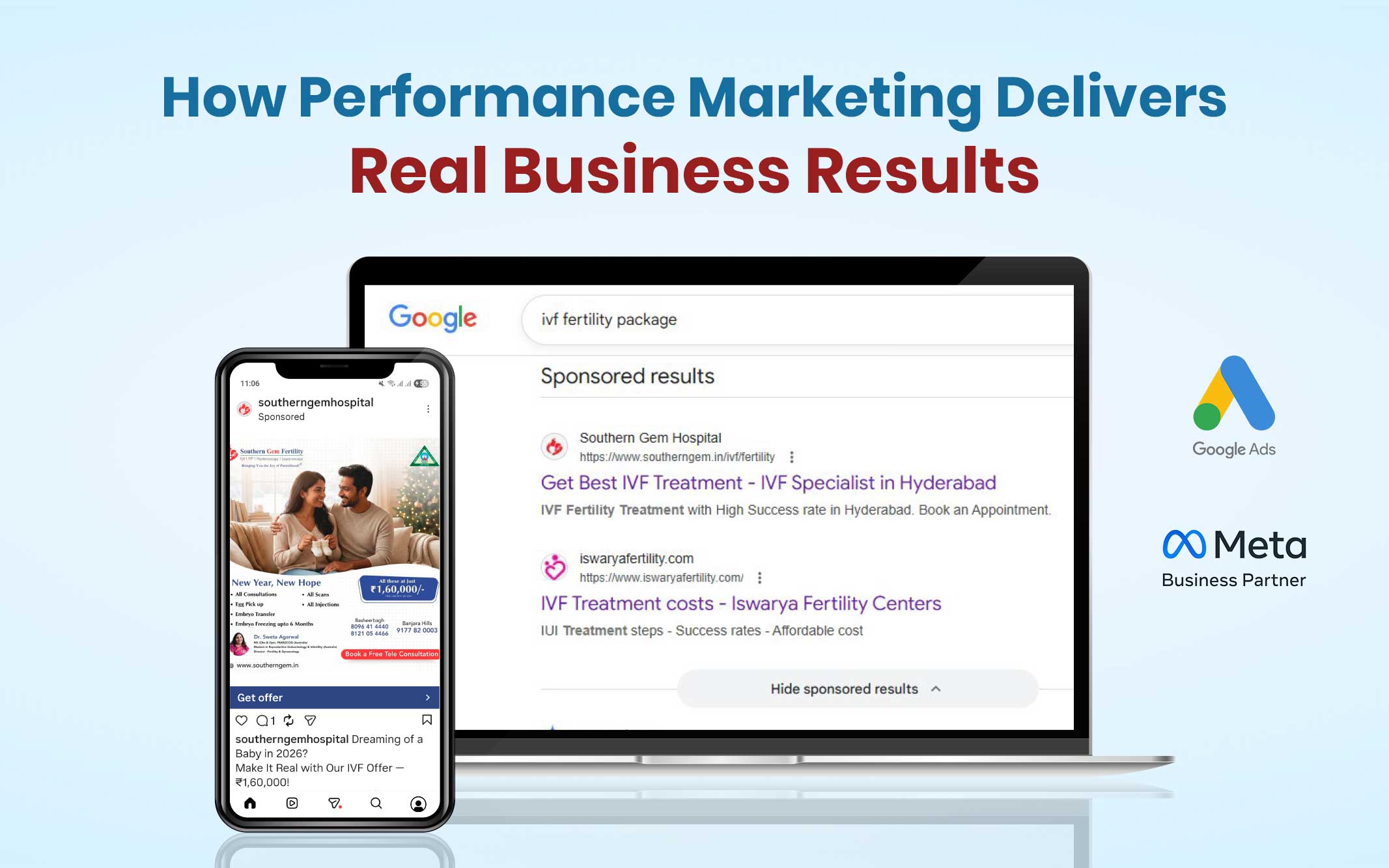
PERFORMANCE MARKETING
It refers to online marketing and advertising programs wherein advertisers pay only when a particular action is completed. Like, a click or a lead or a sale.
Brand awareness campaigns focus on reach and impressions. That is, how many people saw the ad.
Performance marketing, on the other hand, is conversion-based marketing. It gives priority to ‘the outcome’ over the ‘output.’
Now, if the ad does not produce the desired result, the advertiser will not pay. At the very least, the advertiser will have the data to instantly shift spending to a more effective channel.
CORE ELEMENTS OF PERFORMANCE MARKETING
The advertiser (The merchant) : Business looks to sell a product or service.
The publisher (The affiliate / Media) : Platform where the ad appears, such as Google, Meta, YouTube, or a niche blog.
The network / Platform : Tech stack that connects the advertiser and publisher, such as Google Ads or Meta Business Suite.
Outsourced Service Provider : Agencies or specialists who manage online advertising, analytics, and strategy.
SHIFT TO DATA-DRIVEN ADVERTISING
It was the British mathematician and data science entrepreneur, Clive Humby, who said, “Data will be the new oil of the 21st century”, way back in 2006.
He highlighted back then how raw data like crude oil needs refining (analysis) to become the 21st-century digital economy’s valuable driving force.
Data in 2026 will still be the new oil. However, data-driven advertising will be the engine that refines it into profit.
The journey of the modern consumer is no longer linear. He/she could be seeing a video on Youtube Then, three days later, they could be searching on Google for the brand, and finally convert after seeing a retargeting ad on Instagram.
HYPER-PERSONALIZATION AT SCALE
Data allows us to shift to precision targeting away from what’s called the traditional ‘spray and pray’ marketing.
Analyzing specific metrics helps to
- Eliminate guesswork
- Ensure your message reaches the right audience at the optimal time
- Maximize ROI and drive meaningful engagement.
Performance marketers can leverage first-party data and AI-driven insights, deliver the right message to the right person at the exact moment they are most likely to buy.
This is not just demographics (age and location). But it is also about intent signals.
PREDICTIVE ANALYTICS
Businesses can now, with advanced online advertising analytics, predict future behavior based on past actions.
AI models can identify which users have a high chance of buying. This allows marketers to bid more aggressively for those specific individuals, thereby ensuring a higher return on ad spend (ROAS).
BUILDING A WINNING PERFORMANCE MARKETING STRATEGY
- A successful marketing strategy is not built on a single ad.
- It’s rather built on a cycle of testing, learning, and scaling.
- The following details the framework for the high-performing 2026 campaign.
You must, before you spend a single rupee, define what ‘success’ looks like. You should know what you’re looking for.
Is it:
- CPA (Cost Per Acquisition): How much does it cost to get a new customer ?
- CPL (Cost Per Lead): How much for a sign-up or an inquiry ?
- ROAS (Return on ad spend): How many rupees for every rupee spent are returned in revenue ?
CHOOSE THE RIGHT CHANNELS
Not all platforms are the same. Nor are they created equal.
A B2B software company might find its highest ROI on LinkedIn and Google Search. Likewise, a direct-to-consumer (DTC) might live and breathe on TikTok and Pinterest.
A diversified performance marketing strategy will ensure you are not over-reliant on a single algorithm.
CREATIVE OPTIMIZATION
- The ‘CREATIVE’ in 2026 will be the new targeting.
- Search engines and social platforms will come to as privacy regulations make it tougher to trace users via cookies, rely on the ad creative itself. This will help the search engine find the audience.
- If people interact with a video about ‘eco-friendly boot-making’, then the AI will learn to show that ad to more people with identical interests.
ROI-FOCUSED DIGITAL MARKETING: THE BOTTOM LINE
Every business will naturally look for quality returns on its investment.
ROI-focused Digital Marketing focuses more on the metrics that show itself on a balance sheet. Rather than go by what’s called the vanity metrics like ‘Likes’ and ‘Shares.’
EFFICIENCY AND WASTE REDUCTION
Performance marketing is inherently measurable.
This is why ‘Waste’ is identified almost in real-time.
Now, if a particular keyword in a Google Ads campaign is costing Rs 60 per click but has a 0 percent conversion rate, then it’s immediately paused.
The budget for it is relocated to a keyword that’s converting. It is this kind of agility that performance marketing delivers Real Business Growth much quicker than traditional methods.
THE CONCEPT OF ‘INFINITE SCALABILITY
The ability to scale is among the most exciting aspects of an ROI-focused approach.
Your marketing budget becomes an investment if you know that you consistently generate Rs 8,000 in profit for every RS 1,000 you spend.
You can then spend as much as your operations can handle.
ROLE OF ONLINE ADVERTISING ANALYTICS
If you do not or cannot measure, then you cannot manage it.
Online advertising analytics in 2026 will move beyond simple dashboards.
There will be more of:
- Multi-touch attribution (MTA): Gives credit to all the touchpoints a customer interacts with, rather than just the last click.
- Marketing mix modeling (MMM): Uses statistical analysis to check how digital ads interact with offline factors, like economic shifts or seasonality.
- Privacy-first tracking: Uses server-side tracking to maintain the accuracy of data in a ‘cookie-less’ world.
Businesses can, by mastering these analytics, stop spending on ads. Instead, they can focus on ‘investing in customer acquisition.
CONVERSION-BASED MARKETING
The majority of marketers, once the user clicks, tend to make the mistake of thinking the job is done.
However, Conversion-Based Marketing looks at the whole journey. This includes even what happens after the click.
LANDING PAGE OPTIMIZATION (LPO)
Your ad is perfect. But your website is slow or confusing.
It indicates your performance marketing will fail.
A true performance strategy involves
- A/B testing landing pages
- Simplifying checkout flows.
- Ensuring the ‘scent’ of the ad matches the ‘scent of the website.
RETARGETING AND LIFETIME VALUE (LTV)
Real business growth does not just come from the first sale.
Rather, it comes from your repeat business.
Performance marketing leverages data to
- Identify your most valuable customers; and
- Retarget them with upsells, cross-sells, and loyalty offers.
Often, it is 5x cheaper to retain and keep an existing customer rather than to acquire a new one.
FINAL WORD
Performance Marketing is not just a buzzword. It is much more than that.
It’s the operating system of modern commerce.
Your business can, by embracing data-driven advertising and focusing on conversion-based marketing, move away from the ‘hope and pray’ models of the past.
The shift to an ROI-focused Digital Marketing strategy will allow your business to see
- Where your money is shifting to
- Who it is reaching, and
- How much profit is it generating?
The ability to prove your marketing’s value in a business where every rupee counts is the ultimate competitive advantage.
Your business’s future is not found in a bigger billboard. Rather, it is found in a smarter data set.
Frequently Asked Questions
Performance marketing is a results-based digital strategy where you pay only for actions like leads or sales. Unlike traditional advertising that focuses on visibility, performance marketing is data-driven, trackable, and optimised for ROI.
Common performance marketing examples include Google Search Ads, affiliate marketing, retargeting campaigns, and personalised app offers, where brands pay only for clicks, leads, or completed sales.
Performance marketing turns ad spend into a measurable investment. Every rupee is tracked, optimised, and scaled based on data—allowing businesses to test, refine, and grow revenue with confidence.
ROI-focused digital marketing improves ROAS by targeting high-value customers instead of just traffic. It tracks revenue against ad spend, optimises profitable campaigns, and ensures ads contribute to sustainable business growth.
Analytics show how users interact with ads in real time. They enable continuous optimisation, better audience targeting, and ensure every rupee spent delivers measurable results.
Conversion-based marketing reduces waste by focusing only on actions that generate revenue. Instead of paying for impressions or clicks, businesses optimise for leads and sales—cutting waste and improving profitability.
To optimise Google Ads for performance marketing, focus on clear conversion goals, strong audience signals, quality creatives, and accurate tracking. Let automation work with clean data while maintaining control over budgets, bids, and performance targets.